

For the past two years, the software industry has been fixated on model size. Bigger models. Longer context windows. Faster token generation. The implicit assumption has been simple: if the model is powerful enough, it will understand what you need.
In practice, that assumption breaks down inside the enterprise.
A generic AI model can autocomplete syntax. It can generate a function. It can explain an algorithm. But it does not understand your architecture, your internal APIs, your naming conventions, your security policies, or the web of dependencies that make up your system. It does not know which services are mission critical, which teams own what, or which change will cascade into production risk.
That gap between general intelligence and organizational understanding is the real constraint on AI in software development.
Context is the missing layer.
The Illusion of Intelligence
When an AI assistant generates a plausible block of code, it feels intelligent. The syntax is clean. The logic compiles. The suggestion looks reasonable.
But plausibility is not the same as correctness.
Inside a real enterprise codebase, every change exists within a network of relationships. A data model might be referenced by dozens of services. A configuration change might impact regional compliance requirements. A simple refactor might introduce a security regression if it ignores internal policies.
Without context, the model guesses based on statistical similarity. It does not understand the system in which it is operating.
This is why developers often experience a pattern with generic AI tools. The first draft looks impressive. The second iteration requires manual correction. By the third pass, the developer is doing most of the reasoning themselves.
The AI is fluent, but it is not grounded.
Enterprise Software Is a System of Systems
Modern organizations do not operate on isolated repositories. They operate on ecosystems.
There are microservices connected through event buses. Shared libraries maintained by platform teams. Infrastructure as code defining production environments. Security rules embedded in CI pipelines. Documentation scattered across internal knowledge bases.
When a developer asks an AI assistant, “How should I modify this service?” the correct answer depends on:
- The service’s dependencies
- The owning team’s standards
- Downstream systems that consume the API
- Security and compliance policies
- Historical architectural decisions
A model trained on public data has none of that awareness.
What enterprises need is not a smarter autocomplete. They need an AI that understands their world.
Context as a Living Model of the Organization
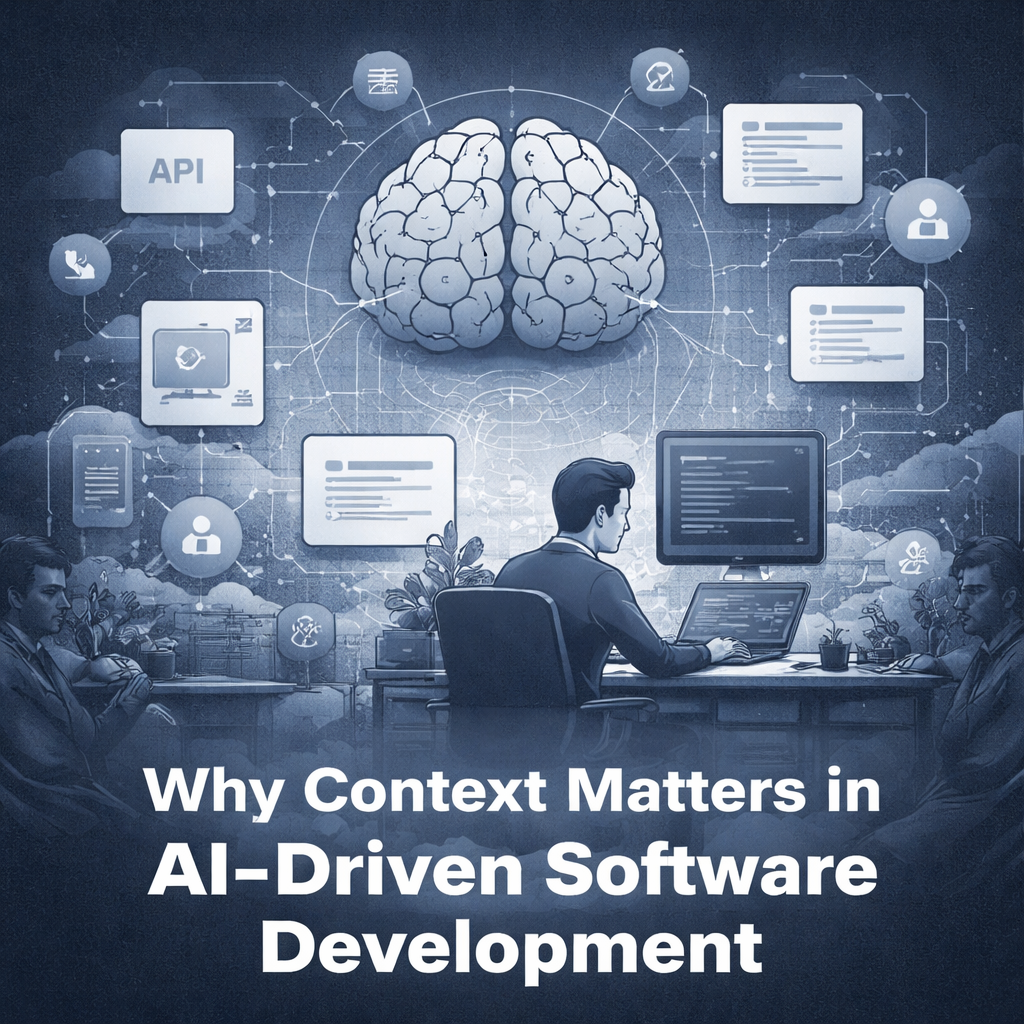
A true context engine builds a structured, living representation of the enterprise software environment. It maps repositories, dependencies, services, documentation, policies, and ownership into a coherent knowledge layer.
Instead of retrieving a few semantically similar files, the system understands relationships.
It knows that Service A calls Service B.
It knows that a schema change affects downstream consumers.
It knows that a specific module is governed by stricter compliance requirements.
When AI operates on top of that context, the behavior changes dramatically.
The assistant can explain impact, not just syntax. It can recommend changes aligned with internal standards. It can reason about architectural consequences rather than generating isolated code fragments.
This is the difference between AI that sounds intelligent and AI that behaves intelligently.
Productivity Without Blind Spots
There is a persistent tension in enterprise engineering. Leaders want velocity. Security teams want control. Legal teams want compliance. Developers want tools that help rather than hinder.
Context resolves that tension.
When AI is grounded in enterprise context, developers move faster because suggestions are relevant and system-aware. At the same time, governance improves because recommendations respect organizational rules and boundaries.
This matters especially as AI agents move beyond code completion into more autonomous workflows. Refactoring services. Generating tests. Updating dependencies. Writing migration scripts.
Without context, those agents operate with partial vision. With context, they operate with guardrails.
Beyond Bigger Models
It is tempting to believe that larger models with longer context windows will eventually solve this problem. But scale alone does not create understanding.
A model can read thousands of lines of code. That does not mean it understands how the system fits together. True understanding comes from structured knowledge of relationships, ownership, dependencies, and policy.
In other words, it comes from context engineering.
Enterprises that treat context as a first-class layer will unlock far more value from AI than those who rely solely on model improvements. They will reduce rework. Improve architectural consistency. Lower risk. Accelerate onboarding. And build trust between engineering and governance teams.
The Future Is Context-Aware AI
AI in software development is no longer a novelty. It is infrastructure.
The question is not whether teams will use AI. The question is whether that AI will operate blindly or with awareness.
Context transforms AI from a probabilistic code generator into a system participant. It aligns suggestions with architecture. It embeds governance into workflows. It turns fluency into reliability.
In the enterprise, that difference is everything.