

I. Introduction: The Power and Limits of the OWASP Top 10
The OWASP Top 10 for LLM Applications has rapidly become one of the most vital frameworks in enterprise AI. It equips security teams with a necessary vocabulary to discuss entirely new risks, such as prompt injection, excessive agency, and vector database attacks. For technology leaders trying to bring order to AI adoption, the framework helps build a mental model to answer a crucial, uncomfortable question: what can go wrong when deploying AI? The framework forces organizations to confront these realities, from employees accidentally exposing sensitive data to malicious documents manipulating a model’s behavior.
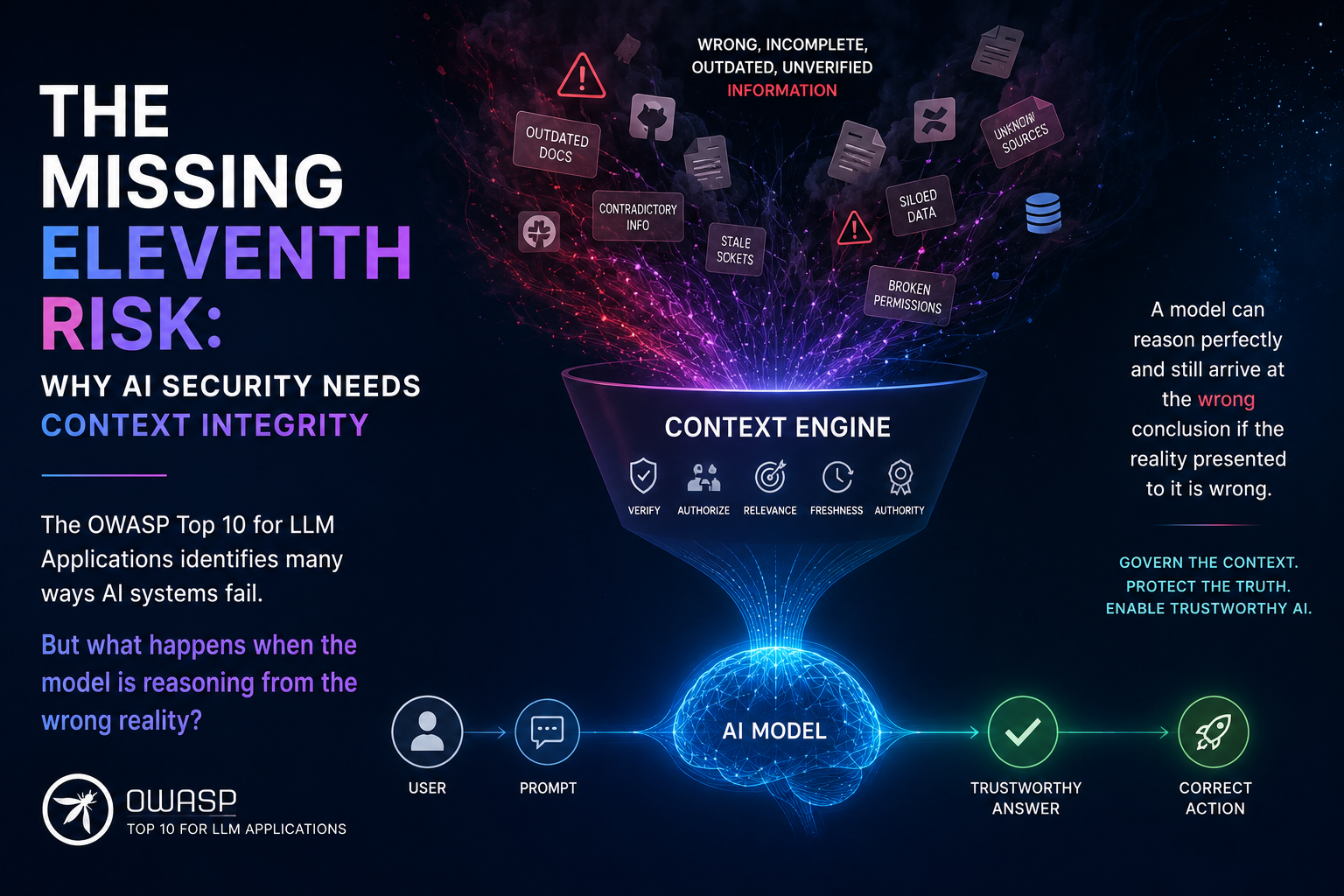
However, after observing the evolution of enterprise AI, it becomes apparent that a critical question is missing: what happens when the AI sees the wrong reality?. The focus has heavily been on poisoned or malicious realities, missing the simple fact that major enterprise AI failures are often not caused by the model itself, but rather by the context it is given.
II. The Enterprise AI Illusion: Constructing Reality Most people hold a simplistic mental model of how AI works: a user enters a prompt, the model processes it, and generates a response. While this may have been somewhat accurate in the early days of ChatGPT, it is entirely disconnected from how modern enterprise AI actually works. If a developer asks how customer authentication works in a payment platform, the answer does not simply sit inside a model like GPT-4. The answer must be assembled.
Systems retrieve information from a myriad of sources, including GitHub repositories, Jira tickets, Confluence pages, architecture diagrams, and engineering runbooks. What enterprises are actually doing in this retrieval process is constructing reality. The model’s entire understanding of an organization is determined by the information presented to it. If the context layer selects the wrong, incomplete, or contradictory information, the model inherently inherits a flawed understanding. The AI can only reason about the world it is shown.
III. The Security Industry’s Historical Bias Historically, the cybersecurity industry has logically focused on protecting systems from malicious actors. The OWASP framework naturally reflects this heritage, assuming malicious intent behind prompt injection, supply chain attacks, and data poisoning. Yet, enterprise AI introduces a fundamentally different category of failure—one that does not require an attacker at all.
Consider an engineering team that migrated to a new authentication architecture eighteen months ago. The migration was successful, but the documentation never fully caught up, leaving a mix of old, new, and non-existent hybrid states recorded. If an AI assistant retrieves three outdated documents and two current ones to answer a developer’s query, it will confidently produce a wrong answer. In this scenario, no prompt injection occurred, no vector database was compromised, and no security boundary was breached. Many organizations are discovering that their AI deployments expose long-standing knowledge management problems, where the AI attempts to consume stale and contradictory information simultaneously.
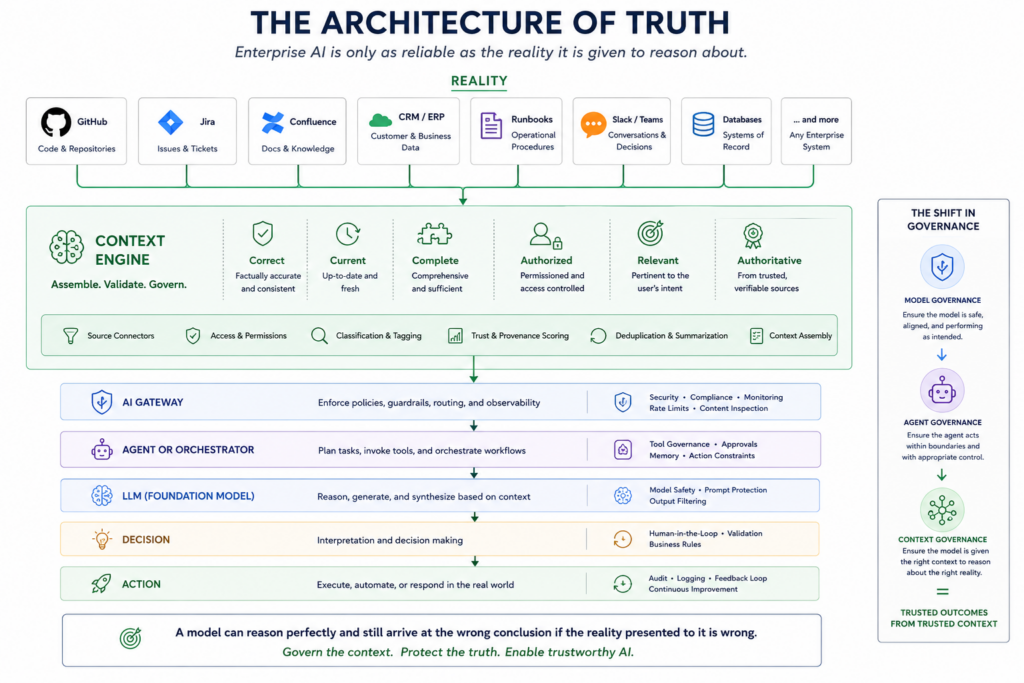
IV. The Missing Concept: Context Integrity While the security industry has spent decades focused on data, system, and software integrity, the enterprise AI era requires a new concept: Context Integrity. Context integrity measures the degree to which information presented to an AI system is correct, current, complete, authorized, relevant, and authoritative.
When context integrity breaks down, AI systems operate on a distorted representation of reality. Even if the model functions perfectly, the prompts are safe, the infrastructure is secure, and governance controls are active, the outcome will be flawed because the model is reasoning about a world that does not actually exist. This proves that bad context is not merely an accuracy issue; it is increasingly a fundamental security problem.
V. Re-evaluating OWASP Through the Lens of Context Although “Context Failure” or “Context Governance” are not named OWASP categories, context quietly influences nearly every risk in the framework.
Take Sensitive Information Disclosure, for example. Organizations typically view this as data leakage after the fact. However, the security boundary increasingly begins at context assembly; a retrieval system or context engine that fails to enforce permissions exposes data long before the model even generates a response.
Similarly, consider Data and Model Poisoning. While deliberate poisoning is a valid threat identified by OWASP, organizations are much more likely to face mundane “knowledge drift”. As documentation ages, processes change, and teams reorganize, repositories fill with historical information that is simply no longer true. From the AI’s perspective, stale information and deliberately poisoned information produce the exact same outcome: both distort reality, degrade trust, and lead to incorrect decisions.
Finally, Excessive Agency is deeply tied to context. While often framed around permissions—such as whether an agent can execute transactions—an agent’s actions are ultimately driven by its understanding, which is shaped entirely by its retrieved context. An agent operating with perfect permissions but flawed context may be just as dangerous as one with excessive permissions. One acts without authorization, while the other acts based on misinformation, yielding remarkably similar outcomes.
| OWASP Risk | Context Impact |
| Sensitive Information Disclosure | Permission-aware retrieval |
| Data Poisoning | Source trust & freshness |
| Excessive Agency | Decision quality |
| Misinformation | Context quality |
| Vector Weaknesses | Retrieval integrity |
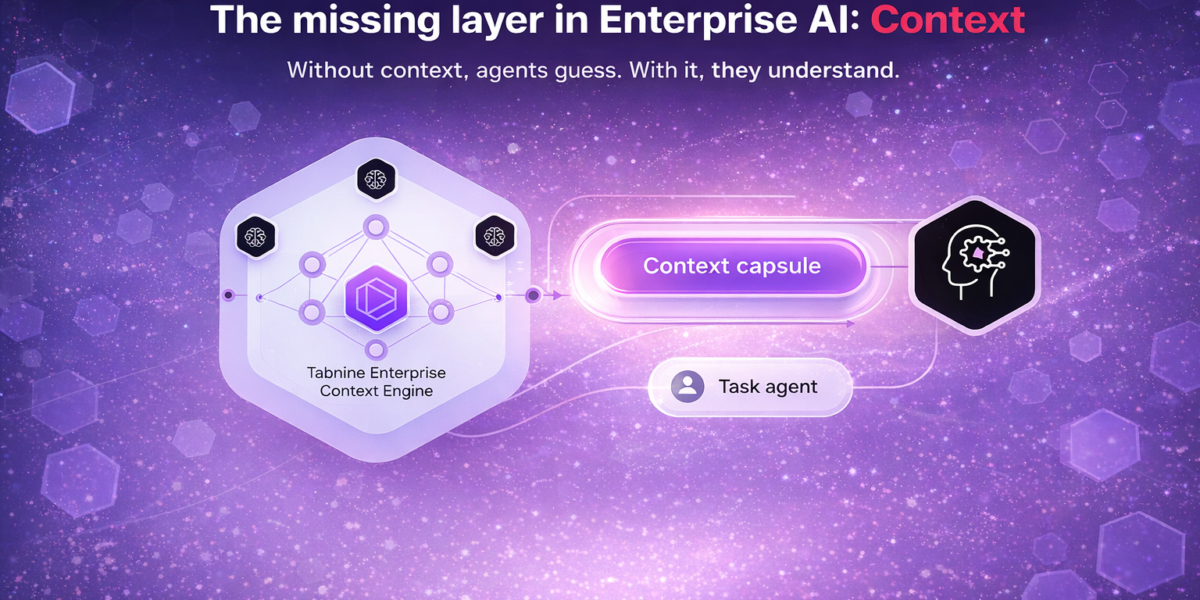
VI. The Context Engine as the New Governance Layer Enterprise AI architectures are fundamentally shifting to accommodate this reality. Historically, workflows evolved from a simple User → Prompt → Model pipeline to incorporate gateways and agents. Today, a new architectural reality is emerging: User → Prompt → Context Assembly → Gateway → Agent → Model → Response.
This Context Assembly layer is the ultimate governance engine. It dictates what information the model sees, which sources are trusted, which permissions are enforced, and which facts are authoritative. In short, it governs the reality presented to the model. Governance over reality is rapidly proving to be just as critical as governance over the models themselves.
VII. Conclusion: Reasoning from Truth None of this diminishes the immense value of the OWASP Top 10. Organizations must continue to invest heavily in baseline controls that address prompt injection, supply chain security, and excessive agency.
However, the future of enterprise AI governance requires a broader perspective. The next generation of failures will not always stem from sophisticated attackers. Instead, they will come from the wrong document, the wrong version, the wrong assumption, and ultimately, the wrong reality. Securing AI is no longer just about ensuring models have the capacity to reason. The ultimate challenge is ensuring they are reasoning from truth.