
Overview
Agent-First Development
Agent-first development is a fundamentally different way of building and operating software. Instead of developers manually monitoring systems, investigating issues, and writing fixes, autonomous agents take on those responsibilities end-to-end.
In this model, agents don’t just assist—they own workflows. They detect production issues in real time, investigate across systems, understand what changed, determine root cause, and generate fixes. Each agent has a defined role, operating in sequence with clear accountability, forming a coordinated system rather than a single monolithic AI.
What makes this possible is the ability for agents to understand the full context of a system—not just code, but infrastructure, deployments, dependencies, and history. With that understanding, agents can behave less like tools and more like experienced engineers operating across the entire software lifecycle
The problem
Why This Breaks Without a Context Engine
Agent-first development sounds powerful in theory, but it breaks down quickly in real-world environments because the necessary context is fragmented and invisible.
When a production issue occurs, the signal might appear in one system, like monitoring. The code that caused it lives somewhere else. The deployment pipeline sits in another tool. Past incidents that could explain the pattern are buried in logs or tickets. No single system contains the full picture, and traditional AI approaches like basic retrieval or code completion only see narrow slices of that reality.
Without unified context, agents operate blindly. They can detect symptoms but can’t trace them back to root cause. They can generate code but don’t understand whether it aligns with the system’s architecture or history. They miss relationships—like the connection between a recent deployment and a spike in errors—or they hallucinate fixes that introduce new problems.
The result is exactly what teams are experiencing today: long investigation cycles, repeated mistakes, architectural drift, and a heavy reliance on human intervention to connect the dots. In other words, without real context, agents can’t behave like engineers—they behave like guessers.
The Solution
Agent-First Development Powered by the Context Engine
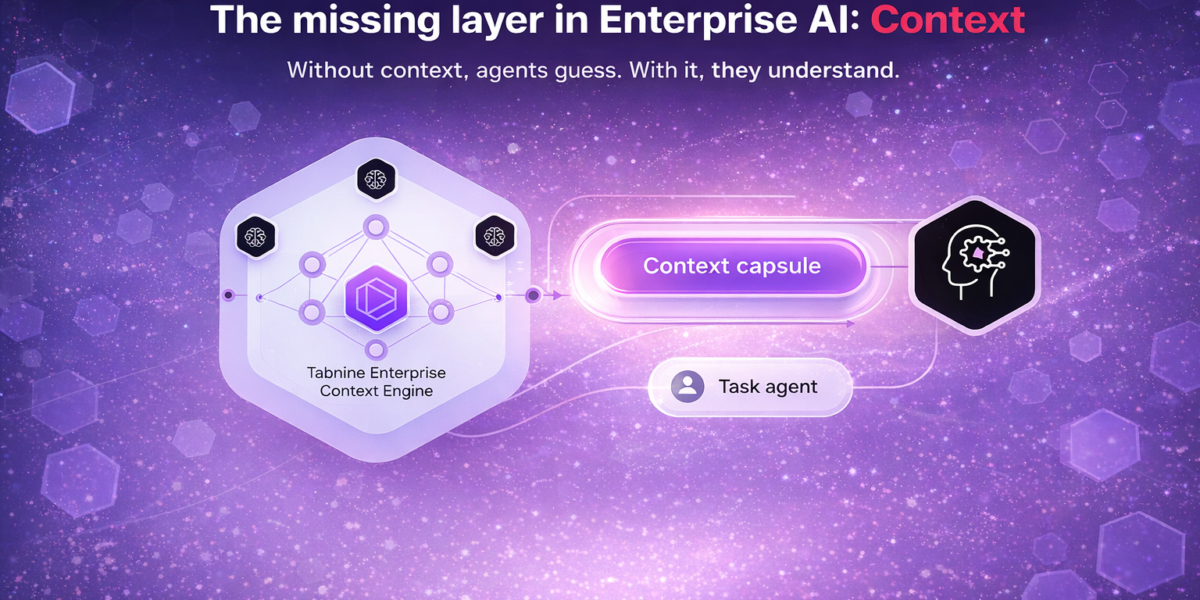
The context engine is what turns agent-first development from theory into reality. It creates a living, structured understanding of the entire system by ingesting data from across the development and production stack—repositories, infrastructure, build pipelines, artifacts, and even past incidents—and organizing it into a knowledge graph of relationships.
This graph connects everything. A running service is linked to the container that deployed it, the build that produced it, the commit that triggered it, and the history that shaped it. That chain of relationships, which is invisible in any single tool, becomes the foundation for intelligent reasoning.
With that foundation in place, agents can operate with precision. A monitoring agent detects an anomaly. An investigator agent traverses the graph to understand the full context—what changed, what’s affected, and whether similar issues have occurred before. It determines root cause and evaluates risk. If conditions are met, it hands off to a specialized autofixer agent, which generates a targeted code change and opens a pull request with a clear explanation.
This isn’t just automation—it’s structured, accountable orchestration. Each agent has a defined role, operates within boundaries, and passes work forward with full context. The system doesn’t just react; it understands.
And critically, the developer remains in control at the final step—reviewing and approving the fix. But everything leading up to that moment, from detection to diagnosis to resolution, happens autonomously.
That’s the shift. From humans stitching together fragmented signals, to agents operating with a complete understanding of the system. From reactive debugging, to intelligent, context-driven resolution. From AI that assists, to AI that executes—safely, reliably, and at scale.