
Overview
Legacy Code Modernization
Modernizing legacy applications is not just a code conversion exercise—it’s a knowledge transfer problem.
Organizations routinely need to move from outdated frameworks and languages to modern stacks, whether that’s server-rendered Java applications to React, or older architectures to new standards. AI can accelerate this process by generating new code quickly, but speed alone isn’t the challenge.
The real requirement is fidelity. The modernized application must behave exactly as intended, align with current standards, and incorporate everything the organization has learned over time.
This is where AI can move beyond simple translation. When properly grounded, it can take an entire body of organizational knowledge and carry it forward into a new implementation—producing code that is not just modern, but correct.
The problem
Why AI-Driven Modernization Falls Short
Most AI-driven modernization efforts fail because they treat the problem as syntax conversion instead of system understanding.
If you point an AI model at a Swagger spec or a legacy codebase, it can generate clean, modern code. But that code is only as good as the inputs it sees—and those inputs are incomplete.
The rules that actually define how the system should behave live outside the code. They exist in issue trackers, where acceptance criteria define UI behavior. They exist in past incidents, where teams discovered failure modes and introduced safeguards. They exist in architectural decisions that dictate patterns, constraints, and standards.
Without that context, the AI produces code that looks right but behaves wrong. It misses conditions like when certain actions should be available. It ignores protections like idempotency keys or debounce logic that were introduced after real-world failures. It fails to align with established design systems or architectural patterns.
The result is a modernization effort that appears successful at first, but quickly breaks down under real usage—forcing teams into cycles of manual correction, rework, and validation. Instead of accelerating development, AI becomes another source of drift.
The Solution
Context-Driven Code Modernization
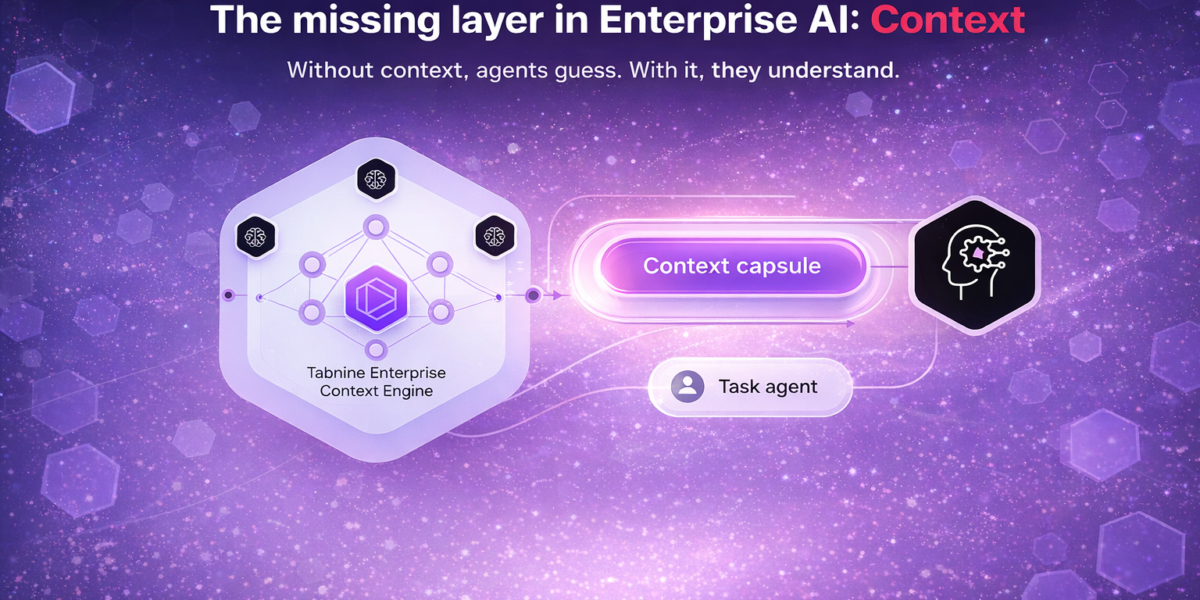
The context engine solves this by giving AI access to the full body of organizational knowledge required to modernize systems correctly.
It ingests and connects data from across the organization—repositories, issues, incidents, and architectural decisions—into a structured knowledge graph. Every requirement, constraint, and lesson learned is linked to the services it affects.
When the AI begins a modernization task, it doesn’t rely on static inputs. It connects to this graph and retrieves the relevant context dynamically. It understands not just what the legacy system does, but how it is supposed to behave, what constraints must be enforced, and what standards must be followed.
As it generates the new application, it incorporates that knowledge directly into the output. UI behavior reflects acceptance criteria defined in issues. Safeguards from past incidents—like preventing duplicate submissions or handling malformed inputs—are preserved in the new code. Architectural decisions are enforced in how components are structured and how errors are handled.
Just as importantly, the process is transparent. The generated code includes traceability back to its sources, allowing developers to see exactly why certain decisions were made and verify that requirements have been met.
The result is a modernized application that is not just syntactically correct, but operationally correct. It behaves as expected, aligns with organizational standards, and avoids reintroducing problems that were already solved.
That’s the shift: from code translation to knowledge-aware modernization. From rewriting applications, to carrying forward everything that makes them work.