

For years, AI in software development has meant one thing: autocomplete.
You start typing a function. The assistant predicts the next line. You accept. It feels fast. Efficient. Almost magical.
And for simple tasks, it is.
But enterprise software is not simple. And autocomplete is not understanding.
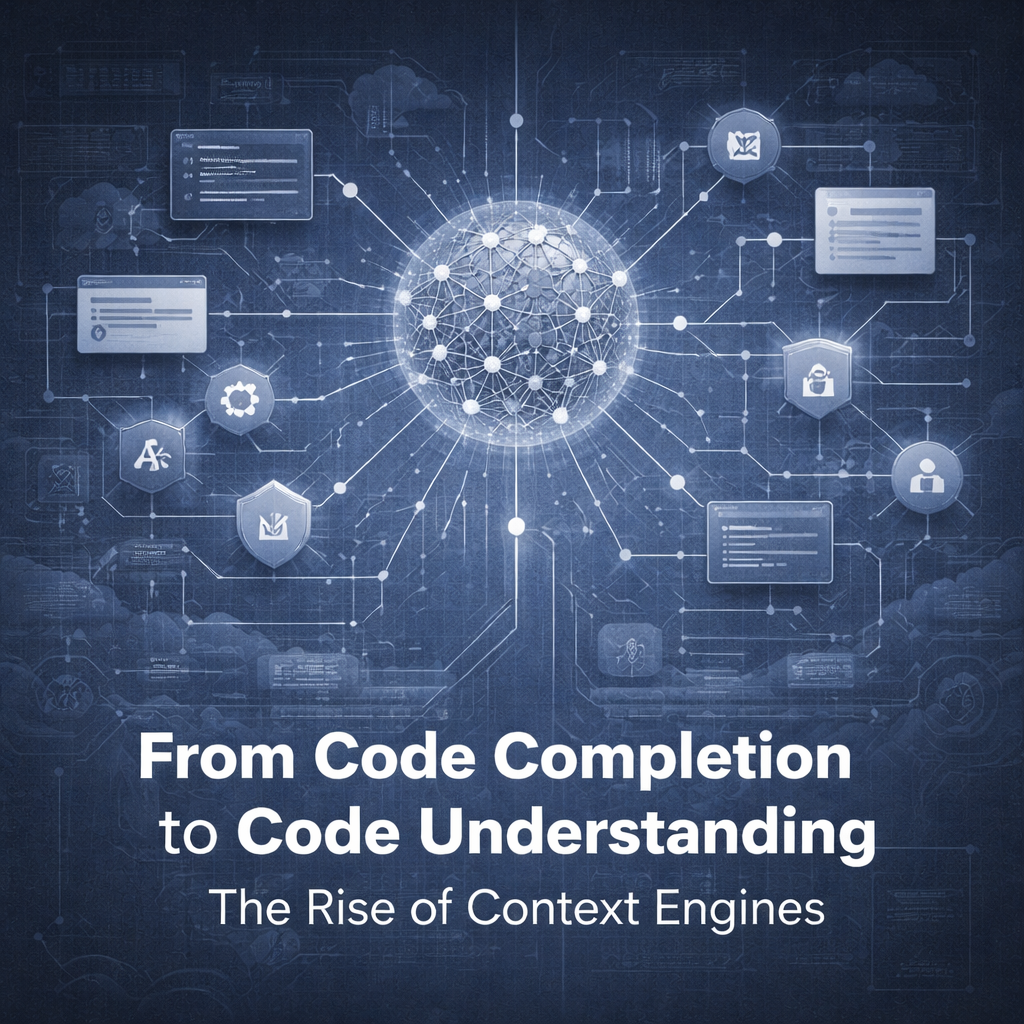
We are now entering a new phase of AI-driven development. The shift is subtle but profound. It is the move from code completion to code understanding.
Autocomplete Was the First Wave
Early AI coding tools were built around prediction. They examined patterns in public repositories and learned how developers typically write functions, classes, tests, and comments. When you typed a few tokens, they predicted what should come next.
This works well for:
- Boilerplate code
- Standard algorithms
- Framework scaffolding
- Syntax-heavy tasks
The model recognizes patterns and completes them.
But this approach has structural limits. It operates locally. It predicts based on surrounding text, not on the broader architecture of your system. It does not reason about ownership. It does not evaluate downstream impact. It does not understand organizational policy.
It predicts. It does not comprehend.
That distinction becomes critical inside enterprise environments.
Enterprises Do Not Need More Predictions
In a real-world codebase, every line is connected to something else.
A model that suggests a method signature does not necessarily know:
- Which services consume that method
- Whether the change violates an internal API contract
- Whether the data model is governed by compliance rules
- Whether a security policy restricts certain patterns
Autocomplete can be statistically impressive and still be architecturally naive.
This is why teams often experience diminishing returns from generic AI tools. The first 70 percent of the suggestion is useful. The remaining 30 percent requires careful human correction because the system does not understand the broader environment.
What enterprises need is not more fluent text generation. They need system awareness.
The Emergence of Context Engines
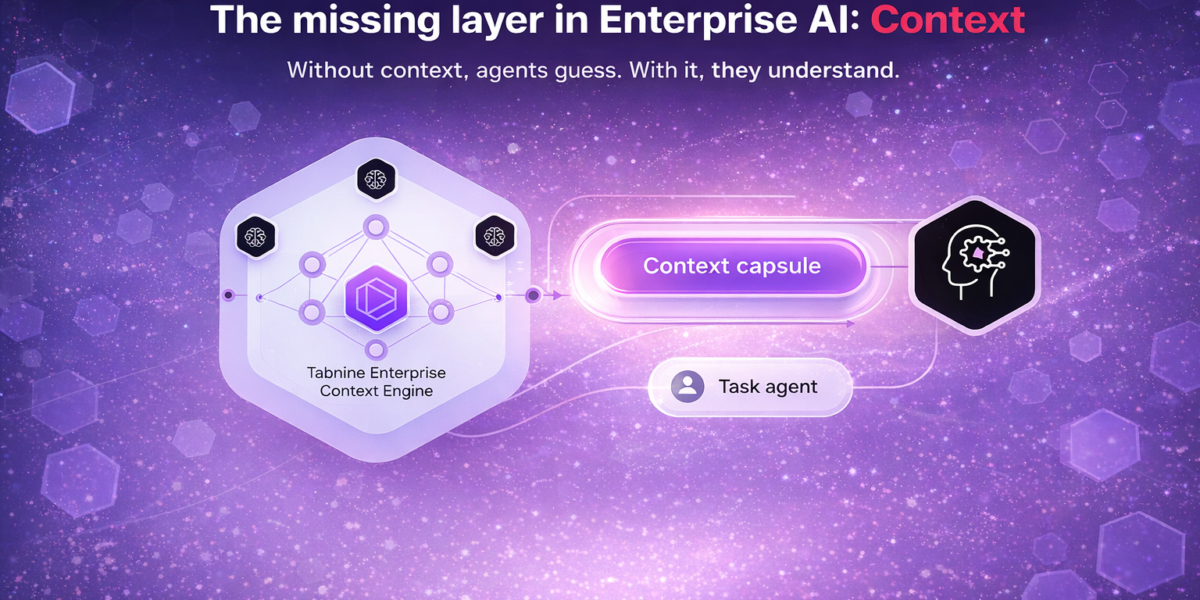
A context engine introduces a new architectural layer beneath AI assistance.
Instead of treating a repository as raw text, it builds a structured representation of the organization’s software landscape. It maps relationships between:
- Repositories and modules
- Services and APIs
- Dependencies and call graphs
- Documentation and code
- Policies and enforcement rules
This creates a living model of the enterprise environment.
When AI operates on top of that model, its behavior changes. It can answer questions like:
What will break if I modify this schema?
Which teams are impacted by this refactor?
Does this implementation align with internal standards?
The assistant moves from predicting the next token to reasoning about the system.
That is the shift from code completion to code understanding.
Understanding Changes the Quality of Output
The difference is not cosmetic. It changes outcomes.
With contextual grounding, AI can:
- Suggest implementations that align with existing architectural patterns
- Reference the correct internal APIs instead of inventing new ones
- Highlight potential side effects before code is merged
- Recommend tests that reflect actual system behavior
In other words, the assistant stops being a fast typist and starts being a system participant.
This is especially important as AI moves into more autonomous roles. Agents are beginning to perform multi-step tasks such as refactoring modules, updating dependencies, or generating migration scripts. Without context, those agents operate with partial vision. With context, they operate with guardrails.
Enterprises cannot deploy autonomous AI safely without this layer of understanding.
Beyond Retrieval
Some teams attempt to solve this problem with basic retrieval techniques. They index the codebase, store embeddings, and retrieve semantically similar files to include in the model’s prompt.
That helps. But retrieval is not understanding.
Retrieval finds text that looks related. A context engine maps relationships that define how the system actually works.
There is a meaningful difference between:
- Showing a model a few similar files
- Giving a model structured knowledge about dependencies, ownership, and policy
The first improves answers. The second changes the nature of reasoning.
The Strategic Implication
The market conversation has largely focused on model capability. Which model is fastest. Which has the longest context window. Which scores highest on benchmarks.
But for enterprises, the real differentiation will not come from model size alone. It will come from the quality of context surrounding the model.
Organizations that invest in context infrastructure will unlock compounding value from AI. Their assistants will become more accurate over time because they are grounded in a stable representation of the system. Their governance controls will be embedded in the same layer. Their AI agents will operate with awareness rather than guesswork.
In contrast, organizations that rely purely on generic models will continue to face the same pattern: impressive drafts followed by manual correction and hidden risk.
The New Baseline for Enterprise AI
We are at an inflection point.
Code completion is table stakes. Every modern IDE can predict syntax. That capability will only improve.
The competitive advantage now lies in system-level understanding.
A context engine transforms AI from a probabilistic suggestion tool into an enterprise-aware collaborator. It aligns outputs with architecture. It respects policy. It surfaces impact. It enables autonomy without sacrificing control.
For enterprise software development, that is not a luxury. It is the next baseline.
The future of AI in engineering will not be defined by how well it completes code. It will be defined by how well it understands the world in which that code lives.