

Here is an uncomfortable fact about AI coding agents: the one your organization standardizes on today will probably not be the best one in eighteen months.
Models improve on irregular schedules. New agents appear quarterly. Pricing shifts. Capabilities leapfrog. The agent you evaluated in January may be outperformed by one that didn’t exist in March. This is not a market failure. It is the expected dynamics of a layer that is commoditizing fast.
And yet, most organizations are building their AI development stack as if the execution layer — the model, the agent — is the permanent fixture. Governance policies are wired to a specific agent’s API. Context integrations are built against a specific vendor’s plugin architecture. Security approvals are granted per-tool.
This creates lock-in. Not contractual lock-in — architectural lock-in. The kind that is harder to see and harder to undo.
The monolith problem
The dominant design pattern in AI coding tools today is monolithic: one vendor provides the model, the agent, the context layer (if any), and the governance layer (if any), as a single integrated stack. The governance only works with that vendor’s agent. The context only flows to that vendor’s model.
This design has an obvious advantage: tight integration. It also has a structural weakness: every component inherits the lifespan of the least durable component.
Models are the least durable component. They improve, get replaced, get repriced, get deprecated. An organization that ties its governance and context infrastructure to a specific model — or a specific agent built on a specific model — rebuilds that infrastructure every time the execution layer changes.
For a team of twenty developers evaluating tools informally, this is manageable. For an enterprise with thousands of developers, compliance requirements, and audit obligations, it is not.
Separating the layers
The architectural insight is straightforward, borrowed from decades of systems design: separate the layers that change at different rates.
The execution layer — which model generates the code, which agent orchestrates the workflow — changes fast. New models ship monthly. Agents fork, merge, pivot. This layer should be swappable with minimal friction.
The organizational layer — governance policies, context graphs, security constraints, deployment topology — changes slowly. It reflects the institution’s accumulated decisions, compliance posture, and architectural standards. This layer should be stable, durable, and independent of any specific executor.
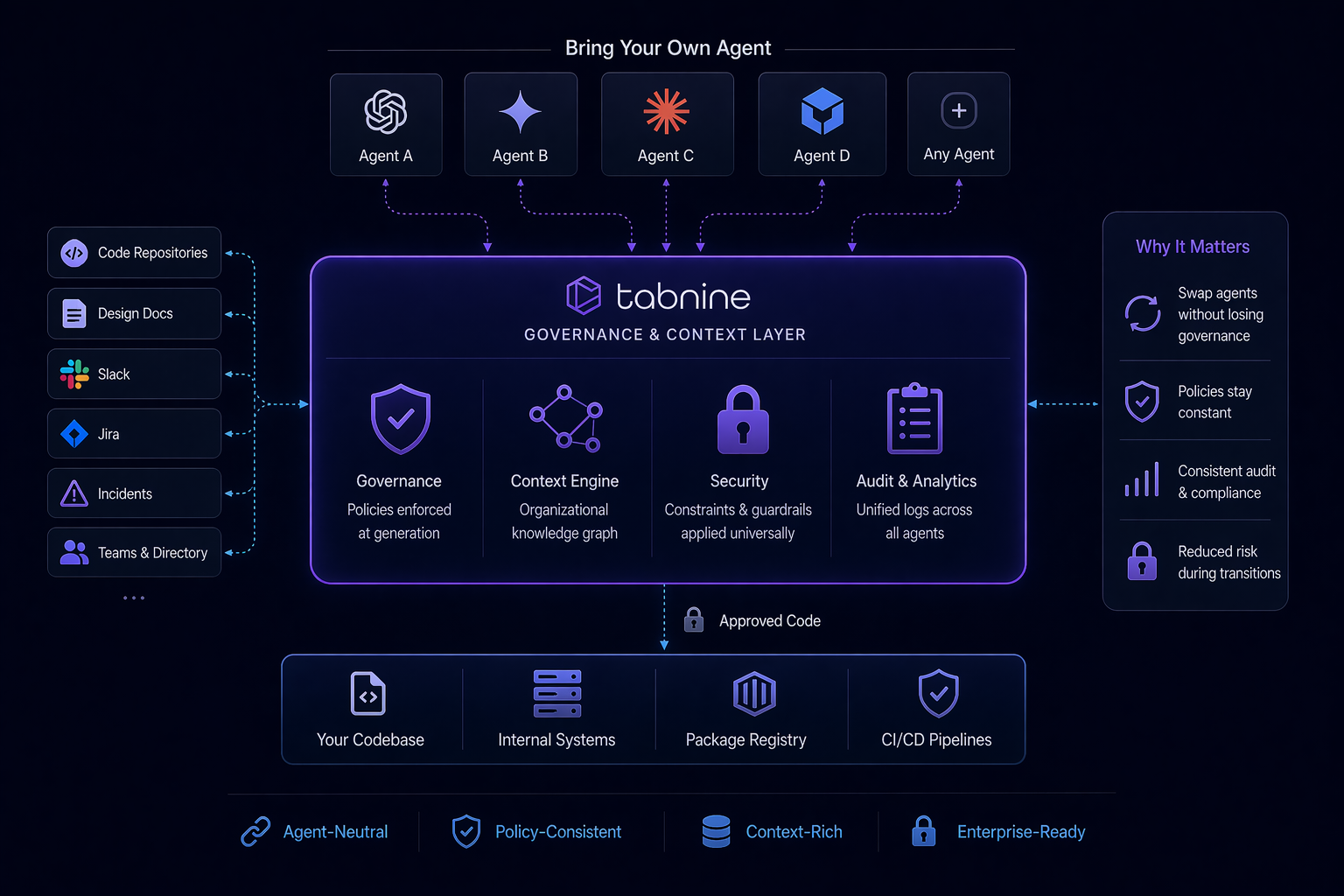
Tabnine’s architecture enforces this separation. The governance layer is not a feature of any particular agent. It sits below the execution layer. That is what makes agent substitution possible without governance regression.
What agent-neutral means in practice
What does agent-neutral governance look like concretely? Four properties.
Governance applies regardless of executor. An architecture constraint, a dependency policy, a security rule — these are defined once in the organizational layer. They apply whether the code is generated by Tabnine’s agent, a third-party agent, or a model accessed directly. The policy doesn’t know or care which agent triggered the generation. It evaluates the output against the organization’s rules.
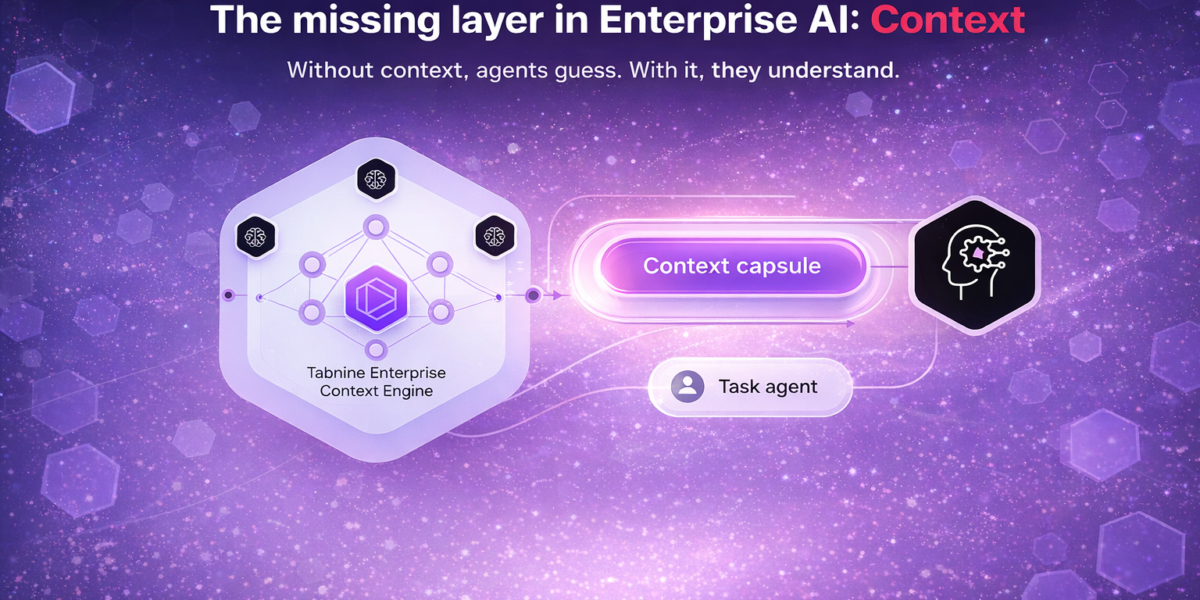
Context flows to any agent. The Context Engine — the organizational knowledge graph we described in week 2 of this series — is not wired to a specific agent’s API. Any agent operating within the platform can query it. An engineer using a third-party agent still gets completions informed by the organization’s architecture decisions, incident history, and dependency policies.
Model choice is the customer’s. The platform is not opinionated about which model powers the execution layer. Customers select models based on their own evaluation criteria — capability, cost, data-residency requirements, existing vendor relationships. The governance layer operates on the output, not the process. It does not require a specific model to function.
Audit is unified. Every agent action — regardless of which agent performed it — flows through the same audit pipeline. One log. One compliance surface. One place to answer the question “what did AI do in our codebase last quarter.”
Neutrality as a security property
There is a subtle but important point here. Agent neutrality is not just a convenience feature or a procurement flexibility play. It is a security property.
When governance is coupled to a specific agent, switching agents means switching governance. During the transition — and transitions are never instant — the organization operates with degraded or absent governance. Policies don’t transfer. Audit logs fragment. Context integrations break.
This is the moment of maximum risk: a new, less-understood agent operating with less governance than the old one. Every agent migration becomes a security event. In practice, we have seen enterprise evaluations stall for months while security teams re-certify a new tool. A neutral governance layer eliminates this class of delay entirely. The agent changes. The governance doesn’t. There is no transition period for policies, no gap in audit coverage, no re-implementation of context integrations. The organizational layer is the constant; the execution layer is the variable.
For CISOs evaluating AI coding platforms, this is the question worth asking: when you switch agents — and you will — what survives the switch?
The durability argument
Enterprise technology decisions are bets on durability. The tools that last are the ones that sit at stable points in the architecture — the layers that don’t need to change when the layers above or below them change.
Operating systems outlast applications. Databases outlast the services that query them. Network infrastructure outlasts the protocols that run on it. The pattern is consistent: the layer that hosts is more durable than the layer that executes.
The same logic applies here. The platform that can host any agent is more durable — and therefore a better institutional bet — than the platform that is one agent. Not because any particular agent is bad. Because the agent layer is, by its nature, the layer that changes fastest.
This is not a prediction about which agent will win. It is a claim about where in the stack durability lives. Governance, context, and deployment infrastructure are institutional assets. They should not be coupled to the component with the shortest half-life.
What we are not saying
We are not saying agents don’t matter. They do. The quality of the agent — its planning ability, its tool use, its code generation — directly affects developer productivity. We are also not saying model choice doesn’t matter. Different models have different strengths, different cost profiles, different data-handling properties. The right model for a regulated financial institution is not necessarily the right model for a startup.
What we are saying is that the decision about which agent to use and the decision about how to govern AI-generated code are separate decisions. They should be made independently, by different stakeholders, on different timescales. An architecture that couples them forces the organization to re-decide governance every time it re-decides execution. That is unnecessary friction, and in regulated environments, unnecessary risk.
Where this sits in the stack
For readers following this series: in week 1, we argued that code generation is commoditizing and the organizational layer is the new differentiator. In week 2, we shipped the Context Engine — the knowledge graph that gives agents organizational memory. In week 3, we announced general availability of self-hosted deployment — the full platform running inside the customer’s trust boundary.
Agent-neutral architecture is the fourth piece. It completes a specific claim: the governance and context layer is independent. Independent of any model. Independent of any agent. Independent of any cloud.