

For nearly two decades, CI/CD has been one of the defining ideas in modern software engineering.
Automate the build. Automate the tests. Automate deployment. Reduce friction. Ship faster.
It worked because the bottleneck in software delivery was the movement of code through the pipeline. The challenge was getting software from a developer’s machine into production reliably and repeatedly without breaking everything along the way.
Today, that bottleneck is shifting.
AI coding assistants and autonomous agents can now generate code, create pull requests, write tests, summarize changes, propose fixes, review implementations, and even participate in incident remediation. Suddenly, the issue is not whether software can move through a delivery pipeline quickly enough. The issue is whether organizations can safely manage the explosion of software changes AI is capable of producing.
That is why Gartner analysts are beginning to discuss something beyond traditional CI/CD. Increasingly, the term entering the conversation is “autonomous software delivery.”
The phrase matters because it reflects a deeper industry realization. Continuous delivery automated the pipeline. Autonomous software delivery automates the work moving through the pipeline.
That is a fundamentally different challenge.
CI/CD Was Built for Human-Paced Development
Traditional CI/CD assumes something very important: humans are still the primary actors creating and validating software changes.
Humans write the code. Humans review the pull requests. Humans decide whether a change should exist at all. The pipeline’s role is mostly operational. Build the artifact, run the tests, validate the deployment, and move the release safely into production.
In many ways, CI/CD automated the transportation system for software delivery.
But AI changes the economics of software creation entirely.
A single engineer can now produce dramatically more output than before. Agents can open pull requests autonomously. Systems can propose refactors across hundreds of repositories. Test suites can be generated automatically. Incident remediation workflows can begin before a human even joins the bridge call.
The volume and velocity of software changes are increasing faster than the governance systems surrounding them.
That is the real transition happening in software engineering right now.
AI Is Expanding Beyond Coding
The market conversation has already moved well beyond autocomplete.
In PwC’s 2026 report on the future of software delivery, the firm describes “the rise of autonomous software delivery” and examines how GenAI is reshaping the software lifecycle across ideation, design, coding, testing, CI/CD, monitoring, and maintenance.
The numbers are difficult to ignore.
PwC found that 84% of organizations reported moderate to significant acceleration in software delivery from GenAI adoption. The same percentage reported meaningful improvements in code quality. Even more striking, organizations automating six or more stages of the SDLC averaged roughly 75 releases per year compared with approximately 31 releases for less mature teams.
That gap is enormous.
The implication is clear. AI is no longer simply helping developers write code faster. It is beginning to reshape the entire software delivery lifecycle.
At the same time, enterprises remain cautious.
JetBrains reported in 2026 that nearly three-quarters of organizations still do not use AI directly inside CI/CD pipelines. The top concerns included trust, unclear operational value, governance, and privacy risks.
That tension is important because it captures exactly where the market sits today. Organizations see the productivity upside of AI-assisted engineering very clearly. What they are less certain about is how to govern systems capable of generating and modifying software at machine speed.
Continuous Delivery Answers the Wrong Questions
Traditional CI/CD systems are excellent at answering operational questions.
Does the code compile? Did the tests pass? Can this build be deployed safely?
Autonomous software delivery requires organizations to answer a very different category of question entirely.
Should this change exist in the first place? Does it violate architectural standards? Which systems and dependencies will be affected? Does the generated code duplicate functionality elsewhere in the organization? Does it introduce licensing or compliance risk? Should an AI agent even be allowed to make this type of change autonomously?
This is no longer merely an automation problem.
It is a context problem. A governance problem. A trust problem.
That distinction matters because many organizations are still approaching AI coding with a “better autocomplete” mindset while the underlying transformation is much larger.
The future delivery system is not just a pipeline. It is an intelligent orchestration layer.
The Delivery Loop Is Changing
For years, the software delivery loop looked relatively simple:
Code → Commit → Build → Test → Deploy
The emerging loop is much more dynamic:
Intent → Context → Plan → Generate → Validate → Govern → Deploy → Observe → Remediate
Notice what changed.
Context became central. Governance became central. Validation became continuous rather than isolated to a single testing phase. Observation and remediation became part of the same autonomous feedback loop.
This is where many current conversations about AI-assisted engineering remain incomplete. Most discussions focus heavily on the quality of the model itself. In reality, the most important question may be whether the system actually understands the organization it is operating inside.
Because enterprise software development is not simply about generating syntactically correct code.
It is about making changes that align with years of accumulated architectural decisions, undocumented tribal knowledge, internal APIs, operational constraints, security requirements, compliance policies, and organizational standards.
Without that understanding, AI does not eliminate complexity. It amplifies it.
The Autonomous Delivery Stack
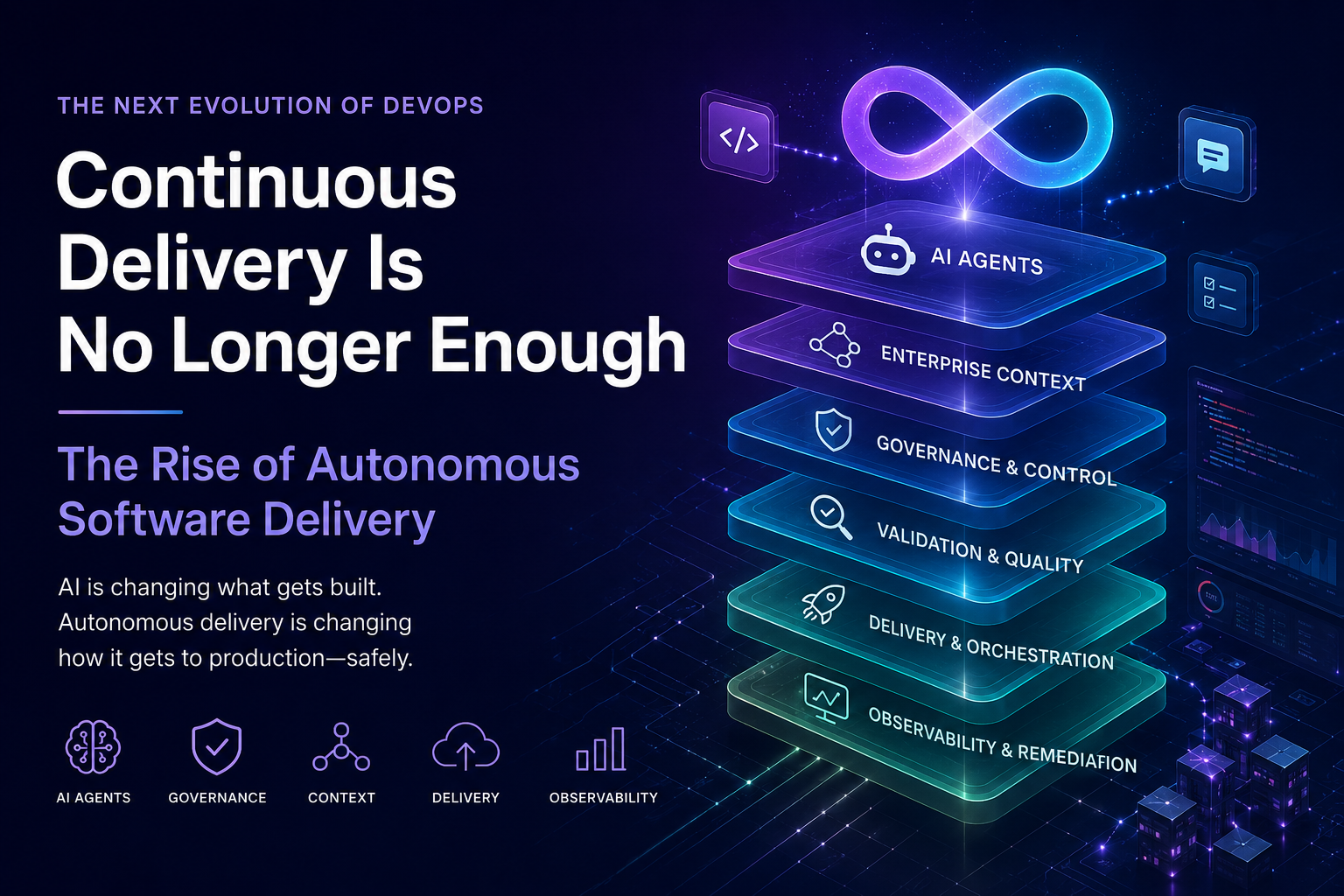
One reason the term “autonomous software delivery” is resonating is because the delivery stack itself is becoming far more sophisticated than a traditional CI/CD pipeline.
In the CI/CD era, the architecture was relatively straightforward. Source control systems connected to build systems, test automation, deployment tooling, and observability platforms. The flow was primarily linear.
The autonomous delivery stack is fundamentally different because AI systems require context, reasoning, governance, memory, and operational boundaries.
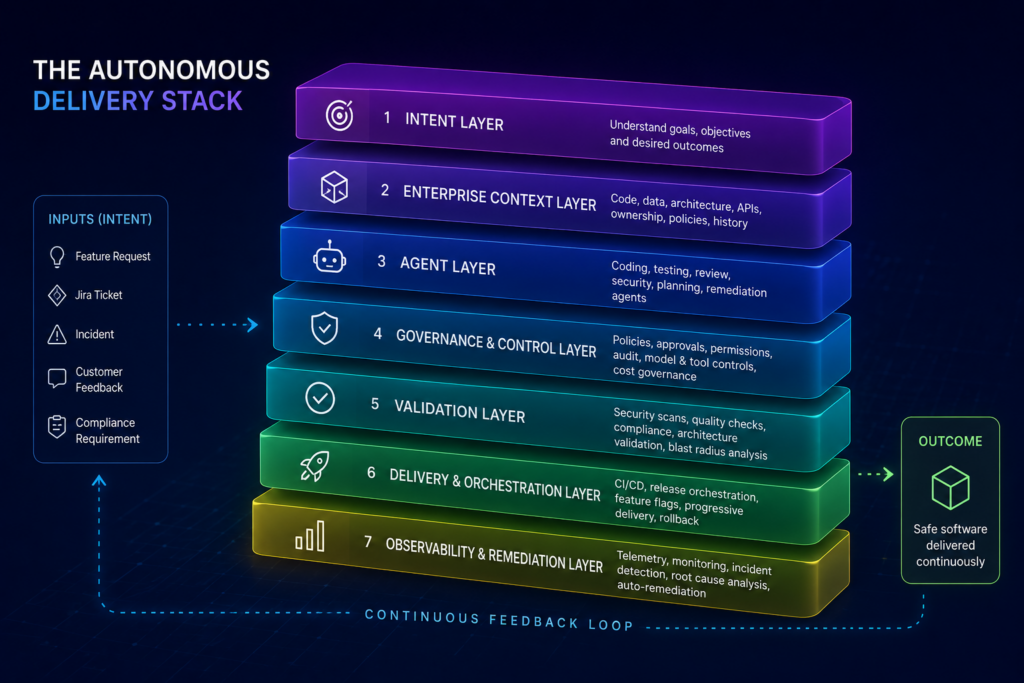
Everything begins with intent. Feature requests, incident reports, Jira tickets, product requirements, customer feedback, and compliance mandates become machine-readable starting points for software activity. Increasingly, systems must understand not just what code should be generated, but why the change exists in the first place.
From there, enterprise context becomes foundational.
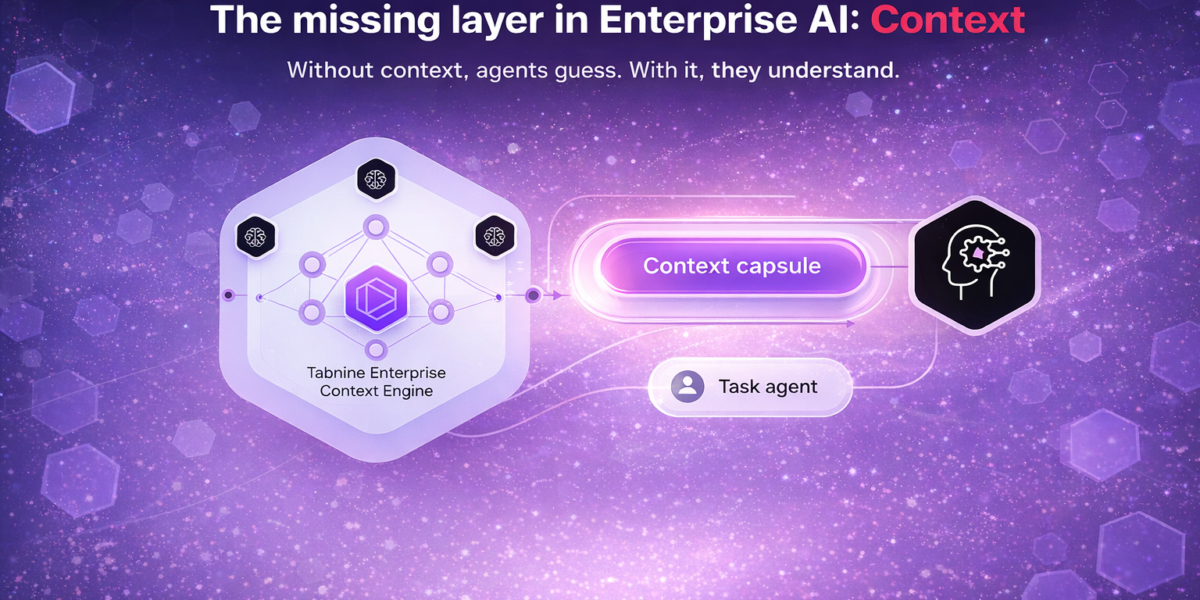
This may ultimately become the most important layer in the entire stack. Autonomous systems need deep understanding of repositories, APIs, dependency relationships, architectural standards, ownership boundaries, historical incidents, internal documentation, and coding conventions. Without this layer, AI agents behave like contractors dropped into a codebase with no onboarding. With it, they begin behaving more like experienced insiders.
The agent layer sits above that context foundation. This is the part of the market receiving most of the attention today. Coding agents, testing agents, planning agents, review agents, security agents, and remediation agents are all beginning to emerge as specialized actors within the delivery lifecycle.
But the more autonomy organizations grant these systems, the more important governance becomes.
That is why governance and control layers are rapidly becoming critical infrastructure for enterprise AI adoption. Organizations increasingly need policy enforcement, approval workflows, audit trails, model controls, tool permissions, provenance tracking, cost governance, and compliance enforcement surrounding AI activity.
This is the shift many organizations are only beginning to appreciate. AI-generated software changes can move far faster than human governance systems were designed to handle.
Validation layers are evolving alongside this change. Traditional CI/CD validation focused primarily on build and test execution. Autonomous delivery dramatically expands the scope of validation into areas like architectural analysis, dependency evaluation, behavioral testing, compliance validation, blast radius analysis, runtime simulation, and operational policy enforcement.
The key difference is that validation becomes continuous and contextual rather than a simple pass/fail gate.
Beneath all of this, the delivery and orchestration layer still matters enormously. CI/CD does not disappear. Build systems, deployment pipelines, feature flags, rollback automation, and release orchestration remain essential. But they increasingly operate as components within a much larger intelligent delivery system.
And finally, the delivery loop no longer ends at deployment.
AI systems are increasingly connected to observability platforms, incident management systems, production telemetry, root cause analysis workflows, and remediation engines. The result is the early emergence of partially self-healing software delivery systems capable of detecting, diagnosing, and resolving certain classes of operational issues autonomously within predefined governance boundaries.
That is a very different world from the CI/CD pipelines most organizations built over the last decade.
Enterprise Context Becomes the Critical Layer
This is why the industry is increasingly converging on the idea that AI agents need far more than larger context windows or vector search.
They need structured organizational understanding.
An autonomous delivery system must understand service relationships, internal APIs, dependency chains, architectural patterns, security policies, compliance requirements, ownership structures, and historical operational knowledge.
Without enterprise context, agents can generate impressive code quickly while simultaneously introducing architectural drift, duplicated functionality, operational instability, and hidden technical debt at scale.
This is one reason many organizations are beginning to rethink what “AI infrastructure” actually means.
The future may not belong solely to the vendor with the smartest coding model.
It may belong to the platforms capable of combining enterprise context, governance, and operational control into a unified delivery system.
Governance Stops Being Optional
For years, developer tooling conversations centered primarily around speed and productivity.
Autonomous systems introduce a new category of concern entirely.
Organizations are now grappling with questions around agent permissions, model access controls, tool governance, auditability, provenance, deployment authority, rollback rights, and operational accountability.
This is where the industry is beginning to mature.
The conversation is shifting from “How fast can AI generate code?” to “How safely can organizations operate autonomous software systems?”
Harness recently described this challenge well when discussing AI-driven delivery infrastructure. The model itself is only one component. The surrounding system must manage context, permissions, policies, tooling, governance, and failure handling.
That observation is critically important because the future enterprise delivery stack is not simply an LLM connected to GitHub.
It is a governed orchestration system for autonomous software activity.
The Real Risk Is Not Bad Code
The industry often frames AI coding risk too narrowly.
The concern is usually that AI will generate insecure or incorrect code.
That risk certainly exists, but it may not be the biggest challenge.
The larger issue is velocity without understanding.
AI dramatically increases the number of changes organizations can produce. But if architectural governance, operational validation, dependency management, review systems, and organizational context do not evolve alongside it, teams may simply accelerate themselves into instability.
GitLab’s recent “AI Paradox” research highlighted this tension directly. Teams are shipping faster with AI assistance while simultaneously experiencing increased fragmentation, quality concerns, and operational complexity across the software lifecycle.
This is the paradox of AI-assisted engineering.
The easier software creation becomes, the more important delivery intelligence becomes.
Autonomous Software Delivery Is Not “No Humans”
The word “autonomous” can create the wrong impression.
This is not about removing humans from software engineering.
At least not anytime soon.
The future is far more likely to involve human-supervised autonomous systems where AI agents handle increasing portions of operational execution while humans provide oversight, governance, architecture, prioritization, and accountability.
AI systems will increasingly generate code, propose fixes, open pull requests, run tests, validate changes, monitor deployments, and analyze production telemetry.
Humans will increasingly define intent, govern risk, approve sensitive actions, manage architecture, resolve ambiguity, and handle exceptions.
That distinction matters because it reframes the role of software teams entirely.
The future engineer may spend less time writing repetitive implementation code and more time orchestrating systems, validating outcomes, and governing intelligent delivery workflows.
The Future of Software Delivery Is Context-Aware
Continuous delivery transformed software engineering because it eliminated friction from deployment.
Autonomous software delivery aims to eliminate friction from the entire software lifecycle.
That requires something much larger than code generation.
It requires systems capable of understanding organizational context, enforcing governance, validating intent, managing risk, coordinating autonomous agents, and safely moving software from idea to production.
The organizations that succeed in this next era will not necessarily be the ones generating the most code.
They will be the ones capable of safely turning intent into production outcomes with trust, visibility, and control.
CI/CD was built for moving software faster.
Autonomous software delivery is about managing software created at machine speed.
That is the shift now beginning to reshape the industry.